
- Bitcoin’s carbon footprint globally stands at 0.19%
- This figure is equivalent to what Czech emits as an entire country
Since Bitcoin came into play, crypto enthusiasts have been championing its mainstream adoption. And while it seemed like it would take a couple of years to convince the global population, the pandemic proved to be one of the most significant crypto driving factors. Between June 2020 and July 2021, Bitcoin recorded an880% surge in adoption.
But, as we welcome the new age of money, we have to think about its negative impacts as well. Banklesstimes.com has been compiling data on the effects of Bitcoin mining on the environment, and the findings are alarming. As of February 2022, Bitcoin’s carbon footprint globally accounts for 0.19%, which is just about what Czech emits as an entire country.
Carbon emission concerns increase following China’s crypto ban
The concerns around Bitcoin mining effects have been a hot debate for quite some time now. While crypto die-hards keep pushing for crypto use in everyday tasks, environmentalists argue it is doing more harm than good.
Elon Musk, a well-known crypto enthusiast, argued that Bitcoin mining was now moving to renewable energy, increasing its green share.
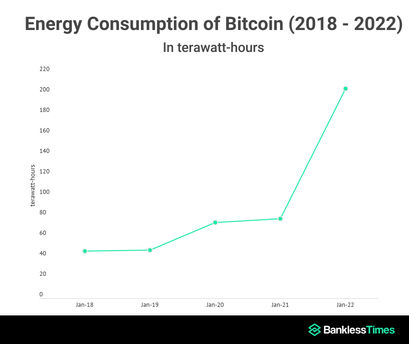
But as recent findings would have it, this is not the case. The Bitcoin mining carbon footprint has been steadily rising, and China’s current ban on crypto use only fueled it further. Research shows that carbon emissions have increased by 17% following the crackdown.
China was a significant Bitcoin hub, accounting for more than 75% of Bitcoin’s hash rate and 44% of crypto miners. That was until June 2021, when the country banned Bitcoin mining. The ban resulted in a mass exodus of miners from China to the US, Russia, and Kazakhstan, where the negative impact is higher.
Now, this may seem absurd, especially because China relies heavily on coal. But, the country also uses renewable hydropower to mine cryptos.
Hydropower and other renewable energy hold the solution
Although things seem bleak right now, there just might be a way out. Going by Musk’s stance, shifting to renewable energy might solve the stalemate between adoption and climate impact.
And it seems that things are already set in motion.
A Costa Rican hydropower plant recently converted into a green Bitcoin mining plant. Sure, the adverse effects on the climate may not start reversing just now, but it is a step in the right direction.
When all’s said and done, cryptocurrency is here to stay, and instead of beating down its adoption, it’s time to find a permanent solution to its carbon footprint.
Alexis Knipe
Show SEO & AI-citation metadata for this article
DemoEvery article carries this structured metadata so it surfaces in search and can be cited by AI answer engines. In the back end, a person posting fills these in, or the AI layer drafts them.